

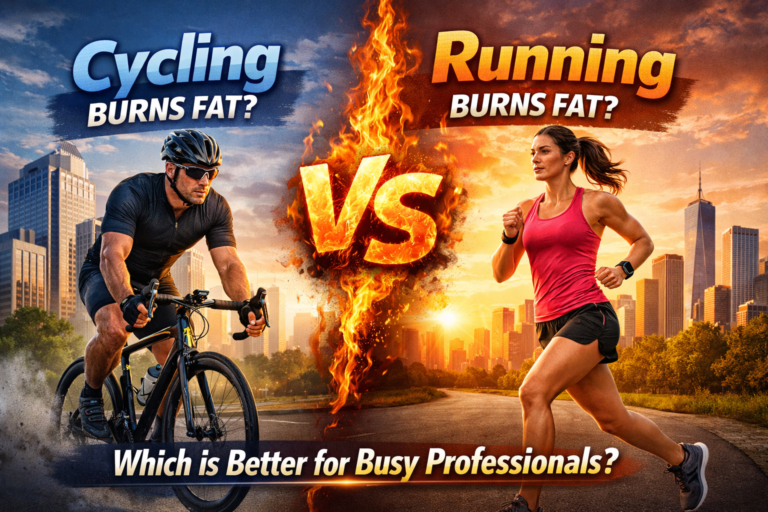
Busy professionals often struggle to balance demanding schedules with fitness goals. The question arises: Cycling vs. Running — which burns fat better? Both are excellent cardio workouts, but their impact on fat loss, time efficiency, and sustainability differs. Let’s break down the science and practicality behind each to help you choose the best workout for your lifestyle. Check out these wearables.
🔥 Fat Burning Potential – Cycling vs. Running
- Running: High-intensity by nature, running burns more calories per minute compared to cycling. A 30-minute run can torch 300–450 calories depending on speed and body weight.
- Cycling: While cycling generally burns fewer calories per minute, it allows longer sessions with less strain on joints. A 45-minute moderate ride can burn 400–600 calories.
Verdict: Running wins in calorie burn per minute, but cycling can match or exceed total burn if you ride longer.
⏱️ Time Efficiency for Professionals
- Running: Requires minimal preparation — just lace up and go. Perfect for professionals with tight schedules.
- Cycling: Needs equipment and sometimes travel to safe routes. However, stationary bikes at home or the gym make cycling more accessible.
Verdict: Running is more time-efficient, but cycling can be equally convenient with indoor options.
🦵 Impact on Joints and Recovery
- Running: High-impact, which can stress knees, ankles, and hips. Recovery time may be longer, especially for beginners or those with joint issues.
- Cycling: Low-impact, making it safer for long-term sustainability. Professionals who sit all day benefit from cycling’s posture correction and muscle engagement.
Verdict: Cycling is gentler on the body, ideal for professionals who want consistency without injury risk.
💪 Muscle Engagement – Cycling vs. Running
- Running: Primarily works lower body muscles but also engages core for stability.
- Cycling: Targets quads, hamstrings, calves, and glutes more intensely. Builds strength while burning fat.
Verdict: Cycling offers better muscle toning alongside fat burning.
🧠 Mental Health Benefits
- Running: Known for the “runner’s high,” releasing endorphins that reduce stress and boost focus.
- Cycling: Provides similar benefits, especially outdoors, where scenery adds relaxation.
Verdict: Both improve mental health, but running’s quick endorphin release may be more effective for stress relief in short sessions.
📈 Sustainability and Lifestyle Fit
- Running: Easier to start but harder to sustain due to impact and injury risk.
- Cycling: More sustainable for long-term fat loss, especially when combined with commuting or leisure rides.
Verdict: Cycling is more adaptable for busy professionals aiming for consistency.
⚖️ The Final Showdown – Cycling vs. Running
- Running: Best for quick calorie burn in short timeframes.
- Cycling: Best for sustainable fat loss, joint health, and overall lifestyle integration.
Answer: For busy professionals, cycling often proves better for long-term fat burning because it’s sustainable, low-impact, and easier to fit into daily routines. Running is excellent for short bursts of calorie burn, but cycling wins the fat-loss battle when consistency is key.
Practical Tips for Busy Professionals
- Mix Both: Alternate cycling and running to maximize fat burn and reduce monotony.
- Use Indoor Options: Stationary bikes or treadmills save commuting time.
- Short Intervals: High-intensity interval training (HIIT) in either workout boosts fat burning.
- Schedule Smartly: Early mornings or lunch breaks are ideal for quick sessions.
- Track Progress: Use apps or smartwatches to monitor calories and fat loss.
Conclusion – Cycling vs. Running
Cycling and running are both powerful fat-burning workouts, but for busy professionals, cycling edges ahead due to sustainability, joint safety, and lifestyle fit. Running remains a strong option for those who want maximum calorie burn in minimal time. The best approach? Combine both strategically to achieve lasting fat loss while keeping workouts enjoyable and practical.
💼 The Bottom Line for Working Professionals
In 2026, fitness technology isn’t just about counting steps—it’s about optimizing health through automation and personalization. Modern wearables and apps like Fitbit Sense 3, Apple Watch Ultra 2, and WHOOP Strap 5.0 now combine AI-driven coaching, stress and recovery tracking, and nutrition insights to help professionals train smarter, not harder. These tools analyze your daily patterns—sleep, stress, and activity—and adapt your workouts automatically, ensuring you get maximum results in minimal time.
🚀 Why It Matters for Busy Professionals
- Efficiency: AI-powered fitness apps adjust routines based on fatigue and recovery, saving time and preventing burnout.
- Integration: Devices sync with smart homes and calendars, turning workouts into seamless parts of your day.
- Accountability: Social features and global fitness communities keep motivation high even when work gets hectic.
- Holistic Health: Beyond physical fitness, wearables now monitor mental well-being, sleep quality, and nutrition—critical for sustained productivity.
🧠 Key Takeaway
For professionals juggling demanding careers, fitness apps and wearables in 2026 act as personal trainers, wellness advisors, and health monitors rolled into one. They remove guesswork, automate progress tracking, and deliver actionable insights—helping you maintain balance, energy, and long-term health without sacrificing work performance.
In short, the future of fitness for busy professionals is data-driven, adaptive, and deeply integrated into everyday life, ensuring that staying fit is no longer a separate task—it’s part of your lifestyle.