

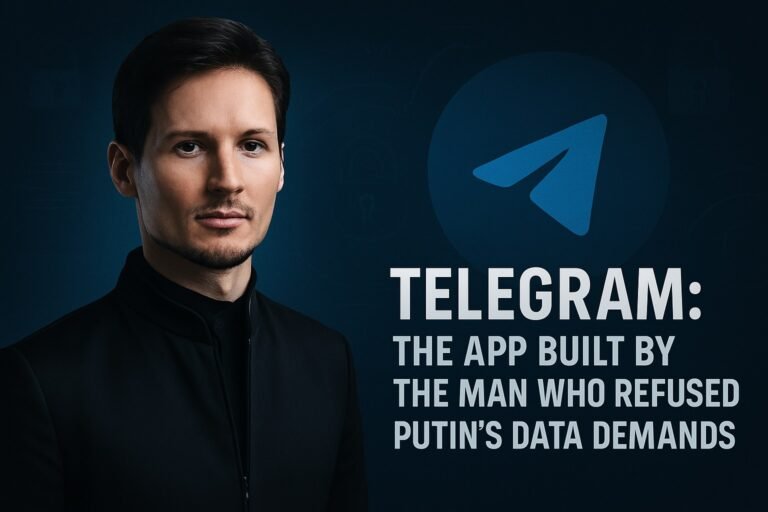
Pavel Durov has become one of the most polarising figures in global tech, celebrated by privacy advocates, criticised by governments, and increasingly scrutinised by regulators. His reputation as the “Russian Mark Zuckerberg” began with VKontakte (VK), Russia’s largest social network, but his global influence exploded with Telegram, the encrypted messaging platform now used by hundreds of millions.
A central theme across his career is his refusal to hand over user data to governments, a stance that cost him control of VK and pushed him into exile. This article traces that timeline and explores the pros and cons of Telegram’s privacy‑first philosophy. Read my blog.
✅ The VKontakte Era: When Durov First Said “No” to the Kremlin
Pavel Durov co‑founded VKontakte in 2006, and by the early 2010s, it had become Russia’s dominant social network. But its popularity also made it a target for government pressure.
2011–2012: Refusing to Block Opposition Groups
During Russia’s mass anti‑government protests, authorities demanded VK block pages run by opposition leader Alexei Navalny and other activists. Durov refused, publicly stating that VK would not censor political content.
This was the first major clash between Durov and the Russian state.
2013–2014: Refusing to Hand Over User Data
Russian security agencies (FSB) demanded that VK provide personal data of Ukrainian Euromaidan activists and Russian opposition figures. Durov again refused.
This refusal triggered escalating pressure:
- Police raided VK’s offices
- Durov’s home was searched
- VK shareholders aligned with Kremlin‑linked interests began pushing him out
By April 2014, Durov announced he had been forced to resign and had effectively lost control of VK. He later stated that staying in Russia was “impossible” without compromising user privacy.
This moment became the ideological seed for another privacy-clad app.
✅ The Birth of Telegram: A Platform Built to Resist Surveillance
After leaving Russia, Durov left the country and began working on Telegram — a messaging app designed to be surveillance‑resistant by default.
Telegram launched in 2013, but its privacy stance became globally visible only after Russia attempted to block it.
✅ 2018: Russia Tries to Ban Telegram — and Fails
In 2018, the FSB demanded that Telegram hand over encryption keys to access user messages. Durov refused, arguing that:
- Architecture made it impossible
- Complying would violate user privacy
- Governments should not have backdoor access to private communication
Russia’s response was dramatic:
- Telegram was officially banned
- Millions of IP addresses were blocked
- Collateral damage disrupted Amazon, Google Cloud, and other services
Despite this, Telegram continued to function in Russia due to technical workarounds and widespread public support.
According to Meduza, the Russian government eventually abandoned its nationwide blocking plans, shifting to a more tolerant stance.
This episode cemented Durov’s global reputation as a privacy hardliner.
✅ 2020–2024: Global Expansion and Rising Scrutiny
The user base surged during:
Its privacy features made it a haven for activists, but also attracted criticism for enabling extremist groups and criminal networks.
By 2024, scrutiny intensified. Durov was even arrested in France in August 2024 on charges related to insufficient moderation on Telegram. While the charges were not about privacy, they highlighted the tension between Telegram’s open philosophy and global regulatory expectations.
✅ Durov’s Philosophy: Privacy as a Human Right
Durov has repeatedly stated that:
- Governments should not have access to private messages
- Encryption backdoors weaken global security
- Users deserve digital independence
This philosophy is consistent and is the reason he left Russia rather than comply with data requests.
✅ Pros and Cons of Telegram’s Privacy‑First Model
Telegram’s design choices have both benefits and drawbacks. Here’s a balanced breakdown.
✅ Pros
1. Strong Privacy Protections
Pavel refusal to hand over data, even under government pressure, has made it a trusted platform for activists, journalists, and dissidents.
2. End‑to‑End Encryption (Secret Chats)
While not the default for all chats, the app offers E2E encryption for secret chats, ensuring messages cannot be intercepted.
3. Decentralised Infrastructure
Telegram uses distributed servers, making it harder for governments to block or seize data.
4. Fast, Lightweight, and Feature‑Rich
- Large file sharing
- Cloud backups
- Channels and groups
- Bots and automation
This makes it more versatile than WhatsApp or Signal.
5. Resistance to Censorship
Telegram has repeatedly survived government bans, including Russia’s failed attempt to block it.
✅ Cons
1. Not All Chats Are End‑to‑End Encrypted
Unlike Signal, Telegram uses server‑client encryption for regular chats. Critics argue this leaves room for potential vulnerabilities.
2. Attracts Criminal Activity
Because Telegram does not moderate aggressively, it has been used for:
- Drug marketplaces
- Extremist propaganda
- Fraud networks
This is part of what led to Durov’s 2024 arrest in France.
3. Governments Increasingly Target Telegram
Countries like Iran, China, and Russia have attempted to restrict or monitor Telegram due to its role in political mobilisation.
4. Centralised Control
The app is still controlled by Durov and his team, meaning decisions are not decentralised like blockchain‑based platforms.
5. No Open‑Source Server Code
The client apps are open‑source, but the server code is not, leading to transparency concerns.
✅ Conclusion: A Tech Rebel Who Changed Global Messaging
Pavel Durov’s journey is a rare story of a founder who chose principle over power. His refusal to hand over user data to Russian authorities cost him his first company, but it also gave birth to one of the world’s most influential messaging platforms.
Telegram’s privacy‑first philosophy has empowered millions, challenged governments, and reshaped digital communication. But it also raises complex questions about moderation, security, and the balance between freedom and responsibility.
Durov remains a controversial figure, admired by those who value privacy, criticized by those who fear the misuse of encrypted platforms. What’s undeniable is that his impact on global digital rights is profound and ongoing.