
Home Blog Page 3

7 Shocking Truths About the Aravalli Controversy You Must Know

The Aravalli controversy has exploded into one of India’s most heated environmental debates of 2025. With the Supreme Court’s recent ruling redefining what qualifies as the Aravalli Hills, critics warn that more than 90% of this ancient range could lose protection. What does this mean for India’s ecology, politics, and future? Let’s dive into the seven shocking truths that everyone needs to know about the Aravalli controversy. Past Articles

Supreme Court Ruling on the Aravalli controversy

In November 2025, the Supreme Court ruling accepted the government’s definition of the Aravalli Hills: only landforms with a relative relief of 100 meters or more qualify. This seemingly technical change has massive consequences. Low ridges, slopes, and shallow hillocks, though ecologically vital, are excluded. Environmentalists argue this opens the door to unchecked development.

Aravalli controversy: Environmental Protection at Risk

The Aravallis act as Delhi’s “green lungs,” filtering pollution and preventing desertification. By narrowing the definition, the ruling threatens environmental protection across Rajasthan, Haryana, and Delhi. Groundwater recharge, biodiversity, and climate regulation could all suffer. Imagine Delhi’s smog worsening without the natural buffer of these hills.

Illegal Mining Could Surge

For decades, illegal mining has plagued the Aravallis. Courts and activists fought to restrict it, but the new definition may weaken safeguards. Vast tracts previously protected could now be exploited for stone, sand, and construction material. This isn’t just about rocks, it’s about livelihoods, ecosystems, and public health.

Save Aravalli Campaign Gains Momentum

Social media is ablaze with the Save Aravalli campaign. Citizens, activists, and politicians are rallying against what some call a “death warrant” for the hills. Hashtags like #SaveAravalli trend daily, with visuals of barren landscapes and urgent calls for conservation. This grassroots movement is forcing the government to respond.

Political Firestorm Around Modi Government & Aravalli Controversy

While Prime Minister Narendra Modi hasn’t personally announced cutting the Aravallis, his government’s Environment Ministry pushed the redefinition. Opposition parties accuse the Centre of siding with developers over nature. The Congress warns of “grave environmental and public health consequences.” The controversy is now both ecological and political.

Why the Aravallis Matter

Stretching 650 km from Delhi to Gujarat, the Aravallis are among the world’s oldest mountain ranges. They:

  • Recharge groundwater aquifers
  • Prevent the Thar Desert’s eastward spread
  • Hosts leopards, hyenas, and diverse flora
  • Moderate to extreme temperatures

Losing protection for 90% of this range isn’t just a local issue; it’s a national crisis.

7What’s Next for India’s Green Future?

Advocates are urging the Supreme Court to revisit its decision. They argue that a height-based definition ignores ecological functions. The coming months will determine whether India strengthens conservation or allows mining and construction to reshape its oldest mountains. The Aravalli controversy is more than a legal technicality—it’s a test of India’s environmental conscience.

Conclusion

The Aravalli controversy is a wake‑up call. The Supreme Court ruling may have narrowed definitions, but the broader fight is about environmental protection, curbing illegal mining, and amplifying the Save Aravalli campaign. As India balances development with ecology, the Aravallis stand as a symbol of what’s at stake. Will we protect our green lungs or watch them vanish under bulldozers?

Quick Take: Illegal mining in the Aravallis has long been a flashpoint, and the Supreme Court’s 2025 ruling redefining the hills has reignited the debate. The new definition excludes 90% of the range from protection, potentially enabling mining and construction. The Save Aravalli campaign is now a nationwide movement, framing this as a battle between development and environmental protection.

🪨 Deep Dive: Illegal Mining in the Aravallis

  • Scale of the problem: Rajasthan alone has over 1.6 lakh hillocks, but only 1,048 meet the new 100‑meter criterion. This leaves vast areas vulnerable.
  • Economic drivers: Demand for construction material (stone, sand, gravel) fuels illegal mining. Local mafias and contractors often operate beyond legal limits.
  • Environmental impact:
    • Loss of forest cover and biodiversity.
    • Groundwater depletion due to disrupted recharge zones.
    • Accelerated desertification, with the Thar Desert creeping eastward.
  • Social consequences: Villages near mining zones face dust pollution, health hazards, and reduced agricultural productivity.

⚖️ Policy Analysis: Supreme Court Ruling

  • The ruling: On November 20, 2025, the Supreme Court accepted the Environment Ministry’s definition: only landforms with relative relief above 100 meters count as Aravalli Hills.
  • Intended rationale: The government argued for a uniform definition to regulate mining leases and prevent ambiguity.
  • Criticism:
    • Exclusion of 90% of hills: Environmentalists call this a “death warrant” for the Aravallis.
    • Loopholes for mining: Former Rajasthan CM Ashok Gehlot termed it a “red carpet for illegal mining”.
    • Ignored ecological functions: Height-based criteria overlook biodiversity, climate regulation, and groundwater recharge.
  • Legal paradox: While the Court paused fresh mining leases in defined Aravalli areas, the narrowed definition drastically shrinks what counts as protected.

🌱 The Save Aravalli Campaign

  • Social media storm: Hashtags like #SaveAravalli dominate X (Twitter), with activists calling the ruling a “death warrant”.
  • Grassroots protests: From Gurugram to Udaipur, citizens, lawyers, and NGOs are staging demonstrations.
  • Political support: Leaders like Ashok Gehlot have publicly backed the campaign, urging reconsideration.
  • Narrative: The campaign frames the Aravallis as “green lungs” of North India, essential for survival.

📊 Risks & Trade-offs

DimensionRisksTrade-offs
EnvironmentDesertification, biodiversity loss, water scarcityShort-term mining revenue
Public healthDust, heat, pollutionEmployment in mining
LegalWeak enforcement, loopholesSimplified definitions
PoliticsPublic backlash, opposition protestsGovernment’s pro-development stance

🔑 Key Takeaways

  • Illegal mining could surge under the new definition.
  • The Supreme Court ruling prioritises uniformity but sidelines ecological realities.
  • The Save Aravalli campaign is reshaping public discourse, making this a national issue.
  • The controversy is a test of India’s environmental conscience—balancing development with protection.

Why the USD Keeps Rising Against INR: 7 Powerful Reasons Driving Rupee Depreciation

The USD to INR exchange rate has been a topic of constant discussion in India. Every time the dollar rate today climbs higher, people wonder: Why does the rupee keep weakening even when the Indian economy is growing?

The truth is, currency movement is shaped by a mix of global forces, domestic pressures, and investor psychology. Let’s break down the 7 most powerful reasons behind the long‑term rupee depreciation trend, in a way that’s simple, strategic, and grounded in how the forex market actually works. Last article on the Bondi Beach terror attack.

1. The #1 Global Force: Massive Demand for USD in International Trade

The U.S. dollar is the world’s primary reserve currency, used in:

  • oil trade
  • machinery imports
  • electronics
  • global settlements

India pays for most of its major imports in USD. This creates constant, structural demand for dollars.

When demand for USD rises faster than supply, the rate naturally climbs.

This is not an India‑specific issue; almost all emerging‑market currencies face the same pressure.

2. Power Shift: High Crude Oil Prices Hit INR Hard

India imports nearly 85% of its crude oil, making it extremely sensitive to global oil prices.

When crude becomes expensive:

Understanding the fluctuations in the exchange rate is crucial for investors and businesses alike.

  • India needs more dollars to buy the same quantity
  • The trade deficit widens
  • The rupee weakens

Oil is one of the biggest reasons behind long‑term rupee depreciation, especially during geopolitical tensions or supply shocks.

The <Strong>USD to INR ratio reflects the demand for U.S. dollars in relation to the Indian rupee.

3. Strong U.S. Economic Data Boosts Dollar Strength

When the U.S. economy performs well, global investors move money into:

  • U.S. bonds
  • U.S. stocks
  • U.S. Treasury markets

This strengthens the dollar and weakens currencies like INR.

Even if the Indian economy is growing, global investors often prefer the safety and stability of U.S. assets during uncertain times.

This is why the forex market reacts sharply to:

  • U.S. inflation data
  • Federal Reserve announcements
  • U.S. GDP numbers

A strong U.S. economy = strong USD.

4. Capital Outflows: Foreign Investors Pulling Money Out of India

Foreign Institutional Investors (FIIs) play a huge role in India’s stock and bond markets.

When FIIs:

  • sell Indian assets
  • Convert INR back to USD
  • move money to safer markets

…the rupee weakens.

This is especially common during:

  • global recessions
  • wars
  • elections
  • interest rate hikes in the U.S.

Even a small outflow can push the exchange rate upward.

5. Interest Rate Gap: U.S. Rates Rising Faster Than India’s

Currencies are heavily influenced by interest rate differentials.

When U.S. interest rates rise:

  • Investors get better returns in the U.S.
  • money flows out of emerging markets
  • The dollar strengthens
  • INR weakens

This is a classic forex market principle called interest rate parity.

If the Federal Reserve raises rates aggressively, the rupee almost always falls.

6. India’s Persistent Trade Deficit Weakens INR Over Time

India imports more than it exports, consistently.

A trade deficit means:

  • More dollars go out
  • Fewer dollars come in
  • The rupee faces long‑term downward pressure

Even if exports grow, India’s import bill (especially oil, gold, and electronics) grows faster.

This structural imbalance is one of the biggest reasons behind rupee depreciation.

7. Safe‑Haven Effect: Global Uncertainty Pushes Investors Toward USD

During global crises, investors rush to the safe‑haven dollar.

Events that strengthen USD:

  • wars
  • pandemics
  • global recessions
  • banking crises
  • geopolitical tensions

When fear rises, the dollar rate today shoots up — even if India is not directly affected.

Fluctuations in the exchange rates can have widespread impacts on the Indian economy.

The impact of global events on the exchange is significant and must be analysed.

This is why INR often weakens during global uncertainty, regardless of domestic economic performance.

Why INR Falls Even When the Indian Economy Grows

This is the paradox most people don’t understand.

A strong GDP does not guarantee a strong currency.

Currencies depend more on:

  • capital flows
  • interest rate differences
  • global risk sentiment
  • trade balance
  • dollar demand

So even if the Indian economy grows at 7–8%, the rupee can still weaken if global conditions favour the dollar.

Will the Rupee Keep Depreciating? The Long‑Term Outlook on USD to INR

Most economists agree that the rupee will continue to weaken gradually over the next decade.

Why?

  • India’s trade deficit will remain high
  • Global demand for USD will stay strong
  • U.S. interest rates may remain elevated
  • India’s import dependency will continue

This doesn’t mean the Indian economy is weak — it simply means the forex market is driven by global forces beyond India’s control.

Final Thoughts: Rates Rising Is Not Always a Bad Thing

A weaker rupee:

  • boosts exports
  • attracts foreign investment
  • increases competitiveness
  • supports IT and service sectors

Many countries intentionally keep their currencies weaker to support exports.

So rupee depreciation is not a sign of failure; it’s a natural outcome of global economics. Let me know your views on the USD to INR rise.

Bondi Beach Terror Attack: What Happened, Why It Matters, and How Australia Is Responding

The world woke up in shock as news broke of a mass shooting at Sydney’s Bondi Beach, one of Australia’s most iconic public spaces. What should have been a peaceful evening of Hanukkah celebrations turned into one of the deadliest terror attacks in modern Australian history, leaving at least 15 people dead and dozens more injured.

This article breaks down everything you need to know about the Bondi Beach Attack: the events, the attackers, the victims, the political fallout, and the broader implications for Australia and the global Jewish community.

Bondi Beach Attack – A Peaceful Festival Turns Into Chaos

Hundreds had gathered at Bondi Beach to celebrate the first day of Hanukkah, a Jewish festival that typically draws large crowds to the beachfront each year. As families lit candles and children played, gunfire erupted without warning.

Witnesses described scenes of panic as people ran for cover, police rushed toward the sound of gunshots, and emergency workers fought to save lives.

According to early reports, 15 people were killed, including one of the gunmen, and 40 others were injured, among them two police officers. Some reports list 12 deaths in the initial hours, but the toll quickly rose as more victims succumbed to injuries.

This was not random violence; authorities have confirmed it was a targeted attack on Sydney’s Jewish community.

Who Were the Attackers in the Bondi Beach Attack?

Police have identified the shooters as a father‑son duo, a detail confirmed across multiple news outlets.

  • One gunman, aged around 50, was killed at the scene.
  • His 24‑year‑old son was critically injured and arrested.

The older attacker reportedly held a firearms licence since 2015, raising urgent questions about Australia’s gun‑licensing system.

Authorities have declared the incident a terrorist attack, citing clear evidence that the shooters intended to target the Jewish community during a religious celebration.

The Hero Who Fought Back

A video circulating online shows a man, identified as Ahmed al Ahmed, bravely confronting and disarming one of the attackers. His actions likely prevented further loss of life.

However, misinformation quickly spread online about his identity and motives, sparking a parallel debate about AI‑generated misinformation and the responsibility of platforms during crises.

Bondi Beach Attack Victims: A Community in Mourning

Among the dead were families, children, and community members who had come together to celebrate Hanukkah. Dozens remain hospitalised, including two police officers who were among the first responders.

The Jewish community in Sydney, one of the largest in the Asia‑Pacific region, is grieving deeply, with vigils held across the city.

Government Response to Bondi Beach Attack: A Turning Point for Australia

Prime Minister Anthony Albanese visited the site, laid flowers, and met with grieving families. He called the attack “a national tragedy” and announced plans for major gun‑law reforms, including:

  • Limiting the number of firearms per person
  • Restricting gun licences to Australian citizens
  • Strengthening the National Firearms Agreement

This marks the most significant push for gun reform since the Port Arthur massacre in 1996.

The attack has also triggered discussions about domestic extremism, antisemitic violence, and public‑space security.

Global Reaction to Bondi Beach Attack

The attack drew swift condemnation from world leaders and organisations:

  • Cricket boards of Australia and England issued statements of solidarity.
  • Players like Pat Cummins urged people to donate blood for the victims.
  • Leaders, including Donald Trump and Benjamin Netanyahu, condemned the violence.

The global Jewish community has expressed grief and outrage, calling for stronger protections against antisemitic attacks.

Why Bondi Beach Attack Matters

This incident is a turning point for Australia for several reasons:

1. A direct attack on a religious minority

The shooting targeted a Jewish festival, raising fears of rising antisemitism.

2. A failure in gun‑licensing oversight

One attacker legally owned firearms for a decade.

3. A challenge to Australia’s sense of safety

Bondi Beach is a symbol of openness, tourism, and multiculturalism.

4. A wake‑up call on misinformation

False narratives spread rapidly online, complicating the crisis response.

Each of these angles opens deeper questions about public safety, community resilience, and national security.

✅ Conclusion: A Nation Shaken, A Community United

The Bondi Beach attack is more than a tragic event; it is a moment that forces Australia to confront uncomfortable truths about extremism, gun control, and the safety of minority communities.

As investigations continue, one thing is clear: Australia will not return to “business as usual” after this. Read my blog for other articles.

IPL Prints Money But Pays No Tax

The Indian Premier League (IPL) is a cultural phenomenon. It’s where cricket meets cinema, where sport meets spectacle, and where money meets more money. With media rights worth tens of thousands of crores, global sponsors, and a fan base that rivals major world leagues, it is easily one of India’s most profitable entertainment products. Read more blogs!

And yet, a question keeps resurfacing:

How can a league this rich be tax‑exempt?

The answer lies in a mix of legal classifications, historical positioning, economic arguments, and the unique structure of Indian sports governance. Let’s break down the 7 shocking reasons behind the IPL’s tax advantage, and why the debate around it is far from over.

1. BCCI’s Charitable Status: The Foundation of the Exemption

The BCCI is registered as a charitable organisation under the category of “advancement of general public utility.” This classification is powerful because:

  • It allows income to be exempt if used for a public benefit
  • Sports promotion is considered a charitable activity
  • The BCCI claims all IPL revenue is reinvested in cricket

This is the legal backbone that shields the league’s earnings from taxation.

2. IPL Was Framed as a Cricket Development Initiative — Not Entertainment

When the IPL launched in 2008, it wasn’t sold as a commercial carnival. It was positioned as:

  • A way to modernise cricket
  • A platform for young Indian players
  • A tool to expand the sport’s reach
  • A format to keep fans engaged

This framing helped the IPL fall under the umbrella of sports development, not commercial entertainment — even though it quickly became a billion‑dollar spectacle.

3. Indian Tax Law Allows “Incidental Commercial Activity” for Charitable Bodies

This is the loophole that changes everything.

Under Indian tax law, a charitable organisation can engage in commercial activity if:

  • The activity is incidental to its main objective
  • The profits are used for charitable purposes

The BCCI argues:

“IPL is a commercial tool to fund cricket development.”

This argument has repeatedly withstood legal scrutiny.

4. The “Not for Private Profit” Structure Strengthens the Case

Even though the IPL generates massive revenue, the BCCI maintains:

  • No individual pockets the profits
  • Money is reinvested in cricket
  • State associations receive funding
  • Domestic cricket benefits from IPL income

This structure enables the BCCI to argue that it is a means to an end, rather than a profit-making enterprise.

5. The Government Still Earns Through Indirect Taxes — A Key Counterpoint

The IPL isn’t “tax‑free.” It’s just BCCI’s income that is exempt.

The government still earns through:

  • GST on tickets, sponsorships, and services
  • TDS on player salaries
  • Corporate taxes on franchises and vendors
  • Taxes on broadcasters
  • Entertainment tax (in some states historically)

This indirect tax ecosystem is massive and often used as a justification for continuing exemptions.

6. Legal Challenges Have Questioned the Exemption — But Never Overturned It

Over the years, tax authorities have argued that the league is:

  • Too commercial
  • Too entertainment‑driven
  • Too profit‑oriented

They point to:

  • Cheerleaders
  • After‑match parties
  • Celebrity owners
  • High‑value sponsorships
  • Global broadcasting deals

Despite these arguments, courts and tribunals have often sided with the BCCI, citing:

  • Its charitable objectives
  • Its non‑profit structure
  • Its reinvestment into cricket

This legal track record has strengthened the IPL’s tax shield.

7. The IPL’s Massive Economic Impact Makes Policymakers Hesitate

The IPL isn’t just a cricket league; it’s an economic engine.

It generates:

  • Jobs (stadium staff, hospitality, logistics, media)
  • Tourism revenue
  • Hotel occupancy spikes
  • Local business boosts
  • Global branding for India
  • International investment interest

This broader economic impact makes policymakers more inclined to support the league, even if it means allowing tax exemptions under existing legal frameworks.

The Bigger Question: Should a Billion‑Dollar League Be Tax‑Exempt?

This is where the debate gets interesting.

Arguments FOR the exemption

  • IPL funds domestic cricket
  • BCCI is a non‑profit body
  • Money goes back into infrastructure
  • The league boosts the economy
  • Taxing it may reduce investment in grassroots cricket

Arguments AGAINST the exemption

  • IPL is clearly commercial
  • It competes with entertainment industries that pay taxes
  • The league earns more than many corporations
  • The “charitable” classification feels outdated
  • Transparency concerns persist

This tension, between law and public perception, between charity and commerce, is what keeps the debate alive.

Conclusion: A League Built on Cricket, Powered by Commerce, Protected by Law

The IPL’s tax‑exempt status isn’t an accident. It’s the result of:

  • Historical positioning
  • Legal classification
  • Economic impact
  • Strategic framing
  • A powerful governing body

But as the IPL grows into a global sports giant, the pressure to revisit its tax status will only increase.

The real question is no longer:

“Why is the IPL tax‑exempt?”

It’s:

“Should it remain tax‑exempt in the future?”

And that debate is just getting started.

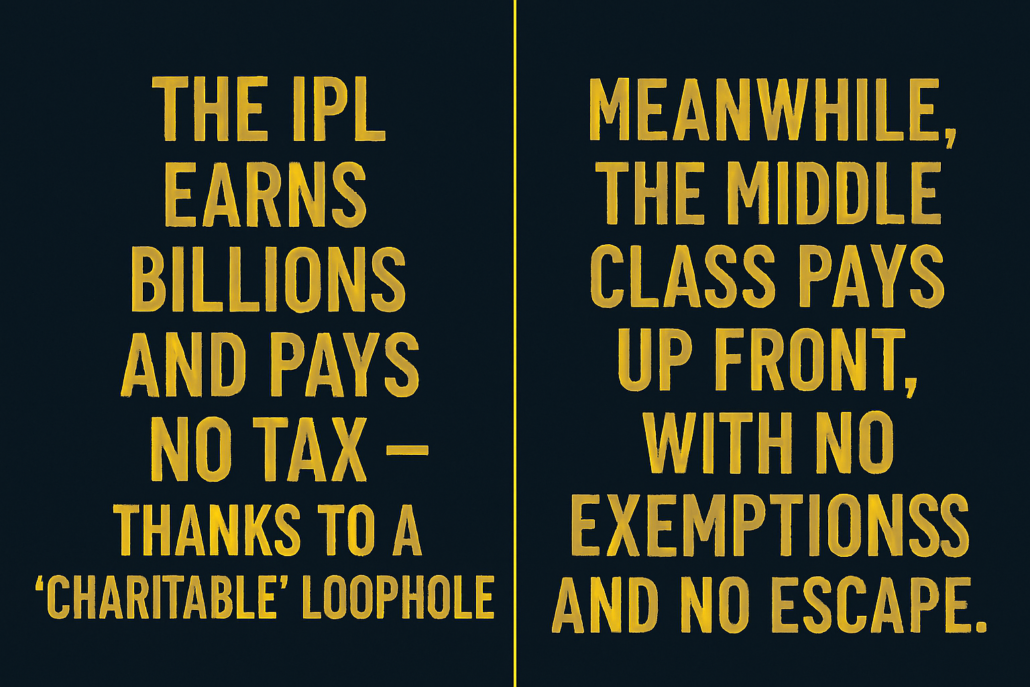
Why IPL’s Tax Exemption Feels Unfair to the Middle Class

IPL Tax benefits vs Middle class

1. Middle-Class Salaries Are Taxed at Source — No Loopholes

  • Salaried individuals earning even ₹5–7 lakh annually face TDS deductions, often without room for negotiation or delay.
  • Meanwhile, the BCCI earns thousands of crores through the league and claims exemption under “charitable activity.”

Contrast: A teacher earning ₹6 lakh pays tax. A cricket board earning ₹6,000 crore from a commercial league? Tax-exempt.

2. No “Charitable Status” for the Middle Class

  • The BCCI uses its “charitable organisation” tag to avoid taxes.
  • Middle-class families donating to temples, NGOs, or schools? They get limited deductions, not full exemptions.

Punchline: The system rewards institutional charity, not individual generosity.

3. IPL Is Entertainment — But Taxed Differently Than Movies

  • A middle-class family buying IPL tickets pays GST.
  • Movie producers, OTT platforms, and musicians pay taxes on earnings.
  • But IPL’s core revenue — media rights, sponsorships — is shielded by BCCI’s status.

Reality check: If IPL is entertainment, why isn’t it taxed like Bollywood?

4. Middle Class Bears the Indirect Tax Burden

  • Fuel, food, services — all taxed.
  • IPL’s ecosystem (vendors, franchises, broadcasters) pays taxes, but BCCI’s central income is exempt.

Effect: The middle class indirectly funds the system while the league’s core profits stay untouched.

5. No Transparency, No Accountability

  • Middle-class taxpayers must file returns, justify deductions, and face scrutiny.
  • BCCI isn’t subject to RTI, and its financial disclosures are limited.

Double standard: Citizens are accountable. Institutions? Not always.

6. The “Public Utility” Argument Feels Hollow

  • The law says “advancement of general public utility” qualifies for exemption.
  • But IPL is a franchise-based, profit-driven league with cheerleaders, celebrity owners, and global sponsors.

Middle-class view: If this is “public utility,” what isn’t?

7. It Reinforces the “Two Indias” Narrative

  • One India: salaried, taxed, scrutinised.
  • Other India: corporatised, exempt, celebrated.

IPL’s tax shield becomes symbolic of how power and privilege bend the rules, while the middle class plays by them.

Telegram The Messaging App Governments Can’t Control Thanks to Pavel Durov

Pavel Durov has become one of the most polarising figures in global tech, celebrated by privacy advocates, criticised by governments, and increasingly scrutinised by regulators. His reputation as the “Russian Mark Zuckerberg” began with VKontakte (VK), Russia’s largest social network, but his global influence exploded with Telegram, the encrypted messaging platform now used by hundreds of millions.

A central theme across his career is his refusal to hand over user data to governments, a stance that cost him control of VK and pushed him into exile. This article traces that timeline and explores the pros and cons of Telegram’s privacy‑first philosophy. Read my blog.

✅ The VKontakte Era: When Durov First Said “No” to the Kremlin

Pavel Durov co‑founded VKontakte in 2006, and by the early 2010s, it had become Russia’s dominant social network. But its popularity also made it a target for government pressure.

2011–2012: Refusing to Block Opposition Groups

During Russia’s mass anti‑government protests, authorities demanded VK block pages run by opposition leader Alexei Navalny and other activists. Durov refused, publicly stating that VK would not censor political content.

This was the first major clash between Durov and the Russian state.

2013–2014: Refusing to Hand Over User Data

Russian security agencies (FSB) demanded that VK provide personal data of Ukrainian Euromaidan activists and Russian opposition figures. Durov again refused.

This refusal triggered escalating pressure:

  • Police raided VK’s offices
  • Durov’s home was searched
  • VK shareholders aligned with Kremlin‑linked interests began pushing him out

By April 2014, Durov announced he had been forced to resign and had effectively lost control of VK. He later stated that staying in Russia was “impossible” without compromising user privacy.

This moment became the ideological seed for another privacy-clad app.

✅ The Birth of Telegram: A Platform Built to Resist Surveillance

After leaving Russia, Durov left the country and began working on Telegram — a messaging app designed to be surveillance‑resistant by default.

Telegram launched in 2013, but its privacy stance became globally visible only after Russia attempted to block it.

✅ 2018: Russia Tries to Ban Telegram — and Fails

In 2018, the FSB demanded that Telegram hand over encryption keys to access user messages. Durov refused, arguing that:

  • Architecture made it impossible
  • Complying would violate user privacy
  • Governments should not have backdoor access to private communication

Russia’s response was dramatic:

  • Telegram was officially banned
  • Millions of IP addresses were blocked
  • Collateral damage disrupted Amazon, Google Cloud, and other services

Despite this, Telegram continued to function in Russia due to technical workarounds and widespread public support.

According to Meduza, the Russian government eventually abandoned its nationwide blocking plans, shifting to a more tolerant stance.

This episode cemented Durov’s global reputation as a privacy hardliner.

✅ 2020–2024: Global Expansion and Rising Scrutiny

The user base surged during:

Its privacy features made it a haven for activists, but also attracted criticism for enabling extremist groups and criminal networks.

By 2024, scrutiny intensified. Durov was even arrested in France in August 2024 on charges related to insufficient moderation on Telegram. While the charges were not about privacy, they highlighted the tension between Telegram’s open philosophy and global regulatory expectations.

✅ Durov’s Philosophy: Privacy as a Human Right

Durov has repeatedly stated that:

  • Governments should not have access to private messages
  • Encryption backdoors weaken global security
  • Users deserve digital independence

This philosophy is consistent and is the reason he left Russia rather than comply with data requests.

✅ Pros and Cons of Telegram’s Privacy‑First Model

Telegram’s design choices have both benefits and drawbacks. Here’s a balanced breakdown.

✅ Pros

1. Strong Privacy Protections

Pavel refusal to hand over data, even under government pressure, has made it a trusted platform for activists, journalists, and dissidents.

2. End‑to‑End Encryption (Secret Chats)

While not the default for all chats, the app offers E2E encryption for secret chats, ensuring messages cannot be intercepted.

3. Decentralised Infrastructure

Telegram uses distributed servers, making it harder for governments to block or seize data.

4. Fast, Lightweight, and Feature‑Rich

Premium Features

  • Large file sharing
  • Cloud backups
  • Channels and groups
  • Bots and automation

This makes it more versatile than WhatsApp or Signal.

5. Resistance to Censorship

Telegram has repeatedly survived government bans, including Russia’s failed attempt to block it.

✅ Cons

1. Not All Chats Are End‑to‑End Encrypted

Unlike Signal, Telegram uses server‑client encryption for regular chats. Critics argue this leaves room for potential vulnerabilities.

2. Attracts Criminal Activity

Because Telegram does not moderate aggressively, it has been used for:

  • Drug marketplaces
  • Extremist propaganda
  • Fraud networks

This is part of what led to Durov’s 2024 arrest in France.

3. Governments Increasingly Target Telegram

Countries like Iran, China, and Russia have attempted to restrict or monitor Telegram due to its role in political mobilisation.

4. Centralised Control

The app is still controlled by Durov and his team, meaning decisions are not decentralised like blockchain‑based platforms.

5. No Open‑Source Server Code

The client apps are open‑source, but the server code is not, leading to transparency concerns.

✅ Conclusion: A Tech Rebel Who Changed Global Messaging

Pavel Durov’s journey is a rare story of a founder who chose principle over power. His refusal to hand over user data to Russian authorities cost him his first company, but it also gave birth to one of the world’s most influential messaging platforms.

Telegram’s privacy‑first philosophy has empowered millions, challenged governments, and reshaped digital communication. But it also raises complex questions about moderation, security, and the balance between freedom and responsibility.

Durov remains a controversial figure, admired by those who value privacy, criticized by those who fear the misuse of encrypted platforms. What’s undeniable is that his impact on global digital rights is profound and ongoing.

IndiGo Airlines Crisis Deepens: DGCA Orders Schedule Cuts, Summons Top Executives as Flight Cancellations Continue

Indigo Airlines’ last article: India’s largest airline, IndiGo, is facing one of the most severe operational meltdowns in its history. What began as a wave of cancellations last week has now escalated into a full‑blown aviation crisis, prompting regulatory intervention, government scrutiny, and nationwide passenger chaos. With over 2,000 flights cancelled daily in some cycles and airports struggling to manage stranded travellers, the situation shows no signs of stabilising quickly.

Here’s the latest, comprehensive breakdown of what’s happening now, and what it means for India’s aviation ecosystem.

DGCA Steps In: Indigo Airlines Ordered to Cut Winter Schedule by 5%

In a rare and strong regulatory move, the Directorate General of Civil Aviation (DGCA) has ordered IndiGo to reduce its winter schedule by 5% to ease operational pressure and prevent further disruptions. This directive is intended to give the airline breathing room to manage crew shortages and stabilise its network.

The DGCA’s decision came after reviewing the scale of cancellations and the airline’s inability to maintain minimum operational reliability. Cutting the schedule is expected to reduce strain on pilots, ground staff, and aircraft rotations — but it also means fewer available seats during a peak travel season.

Indigo Airlines Senior Leadership Summoned

The crisis has escalated to the point where IndiGo’s CEO Pieter Elbers and COO Isidro Proqueras are being summoned by a four‑member DGCA probe panel to explain the operational collapse.

The regulator has expressed strong dissatisfaction with IndiGo’s preparedness and response. According to reports, Indigo Airlines has been “profusely apologetic” and has acknowledged the “compounding effect of multiple factors” that triggered the meltdown.

This level of scrutiny is unusual and signals the seriousness of the situation.

Show‑Cause Notice to Indigo Airlines CEO

Earlier, the DGCA issued a show‑cause notice to IndiGo’s CEO, holding him accountable for the week‑long crisis that stranded thousands of passengers and led to nearly 1,000 cancellations in a single day.

The notice highlighted:

  • Failure to plan for revised Flight Duty Time Limitations (FDTL)
  • Inadequate crew rostering
  • Poor contingency planning
  • Severe passenger inconvenience

The regulator noted that the new FDTL rules were announced months in advance, yet Indigo Airlines did not prepare adequately — a key factor behind the mass cancellations.

Over 250–2,000 Flights Cancelled Daily Across India

Depending on the day and airport, IndiGo has cancelled anywhere between 250 flights to over 2,000 flights daily. This is unprecedented for a single airline in India.

Major airports affected include:

  • Delhi
  • Mumbai
  • Bengaluru
  • Hyderabad
  • Kolkata

Passengers have reported:

  • 6–10 hour delays
  • Last‑minute cancellations
  • Piled‑up luggage
  • Long queues at helpdesks
  • Difficulty rebooking due to high demand

Airfares on alternate airlines have surged as a result.

What’s Causing the Indigo Airlines Crisis? A Deeper Look

IndiGo has cited a “compounding effect of multiple factors”. Here’s what those factors look like:

1. Severe Crew Shortages

The revised FDTL rules require longer rest periods for pilots. IndiGo reportedly failed to adjust rosters in time, leading to widespread unavailability.

2. Over‑ambitious Scheduling

IndiGo’s winter schedule was packed tightly, leaving little buffer for disruptions.

3. Operational Misalignment

Training cycles, aircraft rotations, and crew planning were not aligned with the new regulatory requirements.

4. Passenger Load Pressure

As India’s largest airline, any disruption in IndiGo’s network has a cascading effect across the entire aviation system.

Government Holds High‑Level Review Meeting

A high‑level review meeting was held by the Ministry of Civil Aviation and DGCA at the Union Minister’s residence to assess the crisis and push for immediate corrective measures.

The government is monitoring:

  • Passenger impact
  • Airline compliance
  • Safety risks
  • Market stability

There is also discussion about reallocating IndiGo’s slots temporarily to other airlines to maintain connectivity.

Indigo Airlines Response: Apologies and Assurances

IndiGo has issued multiple statements expressing regret and acknowledging the severity of the situation. The airline claims it is working to:

  • Rebalance crew rosters
  • Improve communication with passengers
  • Stabilise operations within days
  • Cooperate fully with DGCA investigations

However, given the scale of the disruption, recovery may take 1–2 weeks or longer.

Impact on Passengers: What You Should Expect

If you’re flying IndiGo in the coming days:

  • Expect possible delays or cancellations
  • Check flight status frequently
  • Arrive early at airports
  • Keep alternate options ready
  • Document everything for refunds or compensation

Airports remain congested, and rebooking options are limited due to reduced schedules.

What Happens Next?

The next few days are critical. With DGCA’s intervention, schedule cuts, and leadership scrutiny, IndiGo is under immense pressure to restore normalcy.

Key things to watch:

  • Will Indigo Airlines stabilise operations within the promised timeframe?
  • Will DGCA impose further restrictions?
  • Will other airlines step in to fill the gap?
  • How will this affect holiday travel demand?

The crisis has exposed vulnerabilities in India’s aviation infrastructure — especially the dependence on a single dominant carrier.

Final Thoughts

IndiGo’s ongoing crisis is more than just an airline issue — it’s a national aviation challenge. With thousands of passengers stranded, regulatory pressure mounting, and operational cracks exposed, the airline must act swiftly and decisively.

Your readers will appreciate this updated, deeply reported version that builds on your earlier article and positions ShutterholicTV as a reliable source for aviation insights.

IndiGo Airlines Crisis: What’s Really Causing the Massive Flight Disruptions Across India?

IndiGo Airlines Crisis: If you’ve been anywhere near an airport in India lately, you’ve probably seen the chaos: long queues, frustrated passengers, and endless announcements of delayed or cancelled IndiGo flights. What started as a few operational hiccups has now snowballed into one of the biggest aviation disruptions the country has seen in recent years.

IndiGo, India’s largest airline by market share, is under fire from passengers, regulators, and the media — and the situation is still unfolding. So what exactly is going wrong? Why is the airline cancelling hundreds of flights? And what does this mean for passengers in the coming weeks?

Let’s break it down.

A Perfect Storm: How the IndiGo Airlines Crisis Started

The trouble began when IndiGo started cancelling flights in unusually high numbers across major airports like Delhi, Mumbai, Bengaluru, Hyderabad, and Kolkata. What initially looked like routine operational adjustments quickly turned into a nationwide meltdown.

Passengers reported cancellations with little notice, hours‑long delays, and complete lack of communication from the airline. Social media exploded with complaints, photos of crowded terminals, and videos of stranded travellers demanding answers.

Behind the scenes, several issues were converging at once — and IndiGo was struggling to keep up.

1. Severe Crew Shortages: The Core of the IndiGo Airlines Crisis

The biggest trigger appears to be a shortage of cockpit crew, especially first officers and captains. Airlines operate on tight rosters, and even a small disruption can cause a domino effect. But in IndiGo’s case, the shortage was significant enough to cripple operations.

Why the shortage?

  • New DGCA duty‑time rules (FDTL/FOTL) increased rest requirements for pilots.
  • IndiGo allegedly failed to plan rosters around these new norms.
  • Many pilots reportedly called in sick, adding to the strain.
  • Training and transition schedules for new aircraft types further reduced availability.

When pilots aren’t available, flights simply cannot take off — and that’s exactly what happened.

2. DGCA Steps In: Show‑Cause Notice to IndiGo

The Directorate General of Civil Aviation (DGCA) issued a show‑cause notice to IndiGo’s CEO and accountable manager. This is a serious step, signalling that the regulator believes the airline’s planning and compliance were inadequate.

The DGCA questioned:

  • Why IndiGo didn’t anticipate crew shortages
  • Why was contingency planning insufficient
  • Why were passengers not informed in time
  • Why cancellations crossed acceptable thresholds

When the regulator steps in at this level, it’s clear the issue isn’t minor.

3. Operational Mismanagement and Poor Planning: IndiGo Airlines Crisis

IndiGo has blamed “operational requirements,” “airport congestion,” and “technical issues,” but the scale of the disruption suggests deeper structural problems.

Some of the internal challenges include:

  • Over‑ambitious scheduling without adequate crew buffers
  • Rapid fleet expansion without matching manpower growth
  • High dependency on narrow time windows at busy airports
  • Inconsistent communication between operations and ground staff

In short, IndiGo was running a tight ship — until the smallest wave knocked it off balance.

4. Passenger Impact: Chaos at Airports Nationwide: IndiGo Airlines Crisis

The human cost of the crisis has been massive.

Passengers have reported:

  • Being informed of cancellations minutes before boarding
  • Waiting 6–10 hours for alternate flights
  • Missing international connections
  • Being denied refunds or timely rebooking
  • Lack of staff at helpdesks
  • Confusing or contradictory updates on the app and website

Airports like Delhi and Bengaluru saw crowds spilling out of terminals, with passengers demanding answers from overwhelmed staff.

5. Government Pressure and Public Backlash: IndiGo Airlines Crisis

The aviation ministry has taken note, and pressure is mounting on IndiGo to stabilise operations quickly. With the airline handling nearly 60% of domestic traffic, any disruption has a ripple effect across the entire aviation ecosystem.

Public sentiment has also turned sharply negative. IndiGo, once known for punctuality and efficiency, is now trending for all the wrong reasons.

6. When Will Things Return to Normal?

IndiGo has stated that operations will “stabilise in a few days,” but industry experts believe the recovery may take 1–2 weeks, depending on:

  • Crew availability
  • Revised rosters
  • DGCA directives
  • Passenger load during the holiday season

The airline is reportedly working on:

  • Adjusting schedules to reduce strain
  • Bringing in the reserve crew
  • Improving communication channels
  • Coordinating with airports for smoother operations

But until these measures take effect, passengers should expect continued disruptions.

What Should Passengers Do Right Now?

If you’re flying IndiGo in the next few days, here’s what you can do:

  • Check flight status frequently — don’t rely on last‑minute SMS alerts.
  • Arrive early — airports are crowded, and queues are long.
  • Keep alternate flight options in mind in case of cancellations.
  • Use the IndiGo app for faster rebooking.
  • Document everything if you need refunds or compensation later.

Final Thoughts

The IndiGo Airlines Crisis is a reminder of how fragile airline operations can be when planning, manpower, and communication fall out of sync. As India’s largest carrier, IndiGo’s disruptions affect millions — and the airline must act swiftly to restore confidence.

For now, passengers will need patience, backup plans, and a close eye on flight updates. The skies will clear eventually, but the turbulence isn’t over yet. Read more articles.

Bluetooth Earbuds vs Wired Headphones: A Deep Dive into Health, Safety, and Smart Listening

Bluetooth Earbuds vs Wired Headphones: In the age of wireless everything, Bluetooth earbuds have become the go-to accessory for music lovers, gym-goers, and remote workers alike. Sleek, portable, and cable-free, they promise convenience and style. But beneath the surface of this tech marvel lies a growing debate: Are Bluetooth earbuds safe for long-term use? And are wired headphones actually better for your health? If you have an iPhone you check check out these wired earphones. I have been using these for the last 2 years.

Let’s unpack the science, the concerns, and the smarter choices you can make. Read more articles.

🔍 The Rise of Bluetooth Earbuds — and the Radiation They Bring

Bluetooth earbuds work by transmitting audio signals via radiofrequency (RF) waves, a form of electromagnetic radiation. While the levels are low compared to cell phones or Wi-Fi routers, the proximity to your brain makes them a unique concern.

Unlike your phone, which you might keep in your pocket or bag, Bluetooth earbuds sit deep inside your ear canal, just millimetres from sensitive brain tissue. This constant exposure, especially during long listening sessions, has raised eyebrows among researchers and health advocates.

Some studies suggest that prolonged RF exposure may contribute to:

  • Sleep disturbances
  • Headaches or fatigue
  • DNA damage in cells
  • Increased oxidative stress
  • Potential links to cancer (though evidence remains inconclusive)

While major health organisations like the WHO and FDA haven’t declared Bluetooth earbuds unsafe, they do recommend limiting exposure to RF radiation when possible, especially for children and heavy users.

Bluetooth Earbuds vs Wired Headphones

🧠 The Brain Connection: Why Location Matters

In the context of comfort and health, many are debating this comparison.

The human brain is an incredibly sensitive organ, and its proximity to wireless devices matters. Bluetooth earbuds, especially those with active noise cancellation or high-powered chips, emit pulsed RF signals that interact with your body’s natural electromagnetic field.

This can potentially disrupt:

  • Neurotransmitter balance (affecting mood and cognition)
  • Blood-brain barrier integrity
  • Melatonin production (impacting sleep cycles)

While these effects are still being studied, anecdotal reports of discomfort, dizziness, or “brain fog” after extended Bluetooth earbud use are increasingly common.

Check out most celebrities using wired headphones now.

🔋 Bluetooth Earbuds vs Wired Headphones: Heat, Vibration, and Battery Stress

Beyond radiation, Bluetooth earbuds also generate heat and micro-vibrations due to their internal batteries and signal processing. Some users report:

  • Warm sensations in the ear
  • Mild headaches
  • Ear fatigue or pressure buildup

These symptoms may not be dangerous in the short term, but they can contribute to discomfort and long-term weariness — especially for those using earbuds for hours at a stretch.

🎧 Wired Headphones: The Safer, Smarter Alternative?

Wired headphones don’t rely on wireless signals or internal batteries. They transmit audio through physical cables, which means:

  • No RF radiation near your brain
  • No battery heat or signal pulses
  • Minimal electromagnetic interference

While some EMF can travel up the wire from your phone or laptop, it’s significantly lower than what Bluetooth devices emit. For people with EMF sensitivity, neurological conditions, or simply a desire to reduce exposure, wired headphones are a safer bet.

They also tend to offer:

  • Better sound quality at lower prices
  • No latency or connection issues
  • Longer lifespan (no battery degradation)

⚠️ The Precautionary Principle: Why It Matters

Even if Bluetooth earbuds aren’t conclusively harmful, the precautionary principle suggests that we should minimise exposure to potential risks — especially when safer alternatives exist.

This is particularly relevant for:

  • Children and teens, whose brains are still developing
  • Pregnant individuals, where fetal exposure may be a concern
  • Heavy users, such as remote workers, gamers, or frequent travellers

Simple steps like switching to wired headphones, using speaker mode, or limiting earbud use to short sessions can make a big difference.

🧘‍♂️ Wellness Meets Tech: Finding Balance

Technology should enhance our lives — not compromise our health. If you love your Bluetooth earbuds, you don’t have to ditch them entirely. But consider these smart habits:

  • Use one earbud at a time to reduce exposure
  • Avoid sleeping with earbuds in
  • Take regular breaks during long listening sessions
  • Keep volume moderate to protect hearing
  • Store earbuds away from your body when not in use

For those building a wellness routine or recovering from anxiety, burnout, or alcohol-related symptoms, reducing EMF exposure can be a subtle but powerful step toward clarity and balance.

🧠 Final Thoughts: Listen Smarter, Live Better

Bluetooth earbuds are a marvel of modern convenience, but come with invisible baggage. Radiation, heat, and proximity to the brain are real concerns, even if science hasn’t reached a verdict yet.

On the other hand, Wired headphones offer a low-risk, high-quality alternative that aligns with health and performance. Whether you’re a biohacker, a wellness enthusiast, or just someone who wants to listen smarter, the choice is yours.

In a world obsessed with wireless, sometimes the best connection is the one with fewer signals.