
Home Blog Page 21

Importance of quality content in SEO

In my previous article, we talked about four pillars of modern SEO. Quality content or text in SEO is the number one major ranking factor. However, not many people agree with me. Let me explain. Supposing you are looking for a search term on Google. You find a relevant page and looking at the page title and meta description you go on that page. However, you do not find the content of the page relevant to what you were searching for.

You will go back to the SERPs. This will increase the bounce rate of that page and also decrease the session duration. Google takes into account these two factors as well while measuring page ranking. Creating quality content online is something that Googles stresses a lot. This is because Google does not want a bad visitor experience for its users. Let us understand the quality text in SEO.

Hey, seems like you are liking my SEO articles. Subscribe my newsletter for regular SEO updates. It will help you in creating quality text in SEO.

The focus on quality content was stressed much after the Google updates which were released from the year 2011 to 2016. Namely, Panda, Penguin, Hummingbird, Payday loan, mobile-friendly, & Possum update. The importance of quality content in SEO & Quality text in SEO is a must and you should consider writing good content on your webpages.

Google’s definition of good content

Google helps webmasters to create quality content and quality text for SEO. They have laid out directions and guidelines for content creators. They have clearly differentiated between unique good content & un-ethical ways of creating content. Let me explain each of the guidelines in a simple way for you to understand.

Useful content for the visitor

I always create content which the visitors on my web blog want to see. If I get them by spam techniques on my page with content not relevant to them, they will bounce off. This will leave a bad experience for my blog on Google.

Embed search terms

Before creating quality content online, do a lot of keyword research. Google gives you a free tool to do this. It’s called a Google keyword planner. You need to know what people are searching for online. What keyphrases are they searching for? Try to use these search terms on your page. Google crawlers will look them up and this would be very helpful in SEO.

Getting to know the intent is very necessary. For e.g. this page is about quality content. So there are a variety of search terms that I picked up from the keyword planner which users are searching. Furthermore, I have incorporated those search terms in the content of this page. Keyword research helps you to plan your tags and focus keywords better. I use Yoast as an SEO plugin. Their premium version let me rank my page on 5 different key phrases.

Alt text in Images & text for important phrases

We all know that Google crawlers do not recognize text in images. So if you want to highlight any important key phrase of a keyword in your content use it as text. Like for e.g. if you want Google to know that Indian mountain is an important key term in your picture then use it in the text.

The other way around is to write an Alt tag to create a short description of your image. This Alt tag will be read by Google and it will know exactly what the picture is all about. Another thing is that while connecting important keywords with links try to use the anchor text which tells you about the page you are linking to.

<Title> & Alt Attribute should be descriptive

Let us break things up for better understanding. There are three things we are going to talk about. Title, Meta Description, and Alt Attribute here. The title is the first line of introduction of your webpage in search. The title has two tasks. Firstly, to get a user click on your page listing depending upon how user engaging your title is.

Secondly, to tell Google what the page is all about. Try to write a compelling title that should compel a user to click on your webpage listing. This can also be a reason for good or bad CTR. If your CTR is low, try tweaking the title a little. I have found this to be useful in terms of increasing CTR.

A meta description is a small description that is below the title in searches. If you do not specify a meta description Google will pick it up from the content, however, I would recommend you write this as well. A user engaging one, that attracts a visitor to click. This also can be modified and keywords can be induced for a better CTR.

Now let’s look at the Alt tag. These serve two purposes as discussed earlier. Firstly for people who are vision-impaired can use text to speech to identify the images. Secondly, it helps Google crawlers to identify the nature of the image and focused keyword.

The alt tag, Meta descriptions & title can be written with keywords in them to increase the CTR. However, I would advise not to stuff the keyword unnecessarily. Whatever is specified must make sense.

Webpages are for visitors and not for search engines

This is where black hat SEO practices come into the picture. Most of the webmasters including myself used to make pages which could please search engine. I did not pay any attention to what users were looking for. So you could imagine I had little success. However, you need to keep in mind that the webpage is for the user and not for Google.

The best way of writing quality content online is to think like a user. What would you type if you are looking for a specific search term? What should the page include, what shouldn’t be there? These are basic questions that you should ask yourself before creating any content. Look the simple way it works is that if you can keep your visitors happy, Google will be happy.

Make your presence and make your content stand out

Whenever I want to rank any webpage on a keyword, I first look at the top 10 results in Google SERPs. These websites are doing exceptionally well in terms of quality content, CTR, and rankings. Ideally, if I want to beat them I need to deliver something which will make my webpage stand out. What is the point of being and offering something which 100’s or other websites are offering? Try to be unique and offer something new and fresh to your visitors.

Make your presence felt and make your page stand out. Looking at your competitors i.e. the top 10 results on the page will tell you everything that you need to do to make your page stand out. Creating quality content online is a habit and you need to get used to it. You need to consider all the factors which I am listing on this page.

Google tells us to avoid these things

Automated content generators

There are a lot of online free content generators. At all costs avoid these. The content quality coming from these online tools is crappy. Google does not support any automated content which is generated through any third party. I know in order to speed up the process you might have used these generators in the past.

However, if you are still using it please stop. This can get you penalized or worse can permanently get you banned from Google SERPs. The content has to strictly unique and without any plagiarism.

Do not have pages with little or copied content

Do not have pages with little content. There is a minimum word limit that a post or a page should have. Luckily, in WordPress Yoast plugin does this job. 300 words are the bare minimum and for a cornerstone content 900 words and above. However, I consider a good article should have at least 1500 to 2000 words.

Content is indeed the king here. Also, make sure that your content is original and not copied from anywhere else. There are many tools to check plagiarism in content. I do accept guest posts on my blog every now and then. I use a plagiarism checker tool to check if the content is unique or not. Ensure that your content is unique and does not have any copied content.

Some webmasters in past used to hide rich snippets of content on the page. This content was stuffed excessively with keywords in order to rank the page better. However, this used to work in the past and not now. Google algorithms are on the hunt for these hidden texts and hidden links. How did they use to do it?

It’s simple using the same color font as the background. This sounds so funny, but there were webmasters who were doing it. They were doing it with the text and with links both. Ironically, this technique used to work some time back, however after the series of Google updates this does not help. So don’t do it.

Doorway pages

Let us first understand what is a doorway page. The page is created and optimized to rank for a particular keyword only. That is the sole purpose of that page. Then once you start getting a ton of traffic on this page, then you can funnel it through this page to different other pages.

Scrapped content & using synonyms

A lot of webmasters in order to set up their website quickly copied the content from other websites. This scrapped content is bad for your website. Spammers often do this to create content online quickly. Furthermore, webmasters used to change certain words or use their synonyms in the content to make it look unique.

However, with the plagiarism tool in place, Google knows how much unique the content is. Creating quality content online is a time taking and process that requires dedication. There is no shortcut to it.

Participating in an affiliate program without adding too much value.

In one of the previous update, Google came down heavy on those pages which were stuffed with adverts. Quality content comes first then the adverts. I am an affiliate partner of a few brands. Brands like Amazon, Bluehost, SiteGround, Booking.com. All these affiliate links are on my website.

However, I would recommend making a separate page and make it rank for each affiliate program. Simply just putting an affiliate link will not help and Google will not like it. Every link every text should give a unique experience to the user. I have a unique page for the Bluehost affiliates. Check it out if you are looking for hosting plans. I am making other pages too which will go live shortly.

Stuffing pages with keywords

A lot of webmasters still do this. In order to rank their page on a particular keyword, they stuff the content with that particular keyword unnecessarily. When you over the page with the keywords the content looks grammatically incorrect. This even though used to work earlier, but it does not work now after the Google updates. So stop stuffing the content with keywords. Content has to be in a flow and should not look vague & unnatural. Take a look at the example below to understand keyword stuffing better as to what is a Quality text for SEO and how keyword stuffing spoils the whole content.

“Keyword stuffing is bad for SEO. Why keyword stuffing is bad? Well, because Google knows all about keyword stuffing. Keyword stuffing was used by a lot of people. Now, no one uses keyword stuffing anymore”

So you see, the above content looks so unnatural and vague to read.

Stop user-generated spam and indulge in creating quality content

While operating my web blog on WordPress I have seen a lot of incoming comments. Normally, Akismet filter out the spam comments and let me see only the one that I need to moderate. Even moderated comments are sometimes spammy comments. Make sure that you approve only genuine comments and not spam comments. There may be comments like “hey I love your site” or “Nice theme”, do not approve comments like this. If you do it would be user-generated spam. Approve only legitimate comments.

Furthermore, I have seen a lot of people accepting guest posts. It is good provided the content quality is excellent and there is no plagiarism. Just ensure that there are no embedded links in the text pointing to another webpage when you get the guest post. Never allow any author to put any external links in the article, and definitely not use the key-word rich anchor text. If someone wants to include a link pointing to their domain, you should allow this to happen in the author bio section only. Also, check the DA of the domain where the author wants to point.

If you set rules like this, fewer people might be interested in the guest post. However, you will get quality content and improved SEO. Creating quality content online is what we are focusing on and your guest post policies should align with it.

Let’s sum it up

Creating quality content online is a time taking activity, and there is no short cut to it. Do not even try looking for a short cut as that will accumulate a lot of junk content that will not be relevant to the user and hence Google will disapprove it. Let us briefly sum up a few key points.

  • Content has to be created for the user and not for the search engine. Create what you would like to see. It should add value and there should be no keyword stuffing.
  • If you want to be the best then take out the best. This is true, look at the top 10 results and try and come out with something which is unique and is not included in the top 10 results.
  • Getting visitors to your website might be easy, however, retaining them is tough. Try and create quality text for SEO regularly and give your visitors something new every time so they keep coming back to your page.

In the end would like to say that whatever your niche is, the content has to be top-notch. Quality text for SEO is what everyone strives for but few get the way to it. That’s what would get you to the top. If you have any questions here, please leave them in the comments section. I would love to answer them.

Four Pillars of Modern SEO

Welcome to yet another article on SEO. In this article, we would discuss the four pillars of modern SEO. In other words, four major SEO ranking factors post Penguin update. Google pay weightage to these factors as compared to any other ranking factor. I do a lot of freelancing SEO projects, and I have always tried to be on the white hat SEO side. However, I did try black hat SEO on a few of my projects.

The gains were phenomenal. However, the penalty was also phenomenal. Even though some of my clients push me for fast goals, but these goals are not realistic. I always think of long-term gain and not short-term. So I have stopped applying black hat SEO techniques to my work. Better late than a sorry mate.

Take a moment to look at my life on my YouTube channel

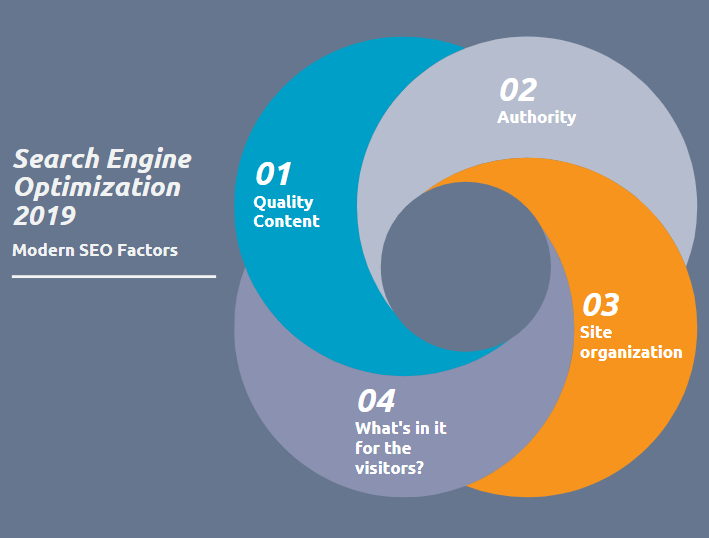
We know that Google judges webpages analyzing over 200 different indicators. However, over years I have realised that there are four pillars to modern SEO. If you control these four pillars, you can rank well on SERPs. I will discuss these major SEO ranking factors in details in my upcoming articles, but let’s briefly describe them. Take a look at the diagram below.

Four pillars of modern SEO are quality content, site organization. authority and what's in it for the visitor?
Major criteria for ranking in modern SEO

As I said we would be discussing these factors in detail. My upcoming articles will have comprehensive articles about each one of them. Furthermore, I would also tell you how you can strive to achieve these factors. Let us quickly define each one of them as of now.

  1. Quality Content: If you remember my article on Panda and Penguin update you would realize that Google was pushing webmasters for getting quality content. Who would like to read crappy content on the page? So make sure that whatever content you are posting should be of high quality.
  2. Authority: It is important to build links and to increase your domain authority. More the DA & PA more will be the visibility in SERPs.
  3. Site Organization: A healthy and easy to navigate structure is very necessary. Visitors coming on your website should not feel lost and should be able to navigate through the menu and other items easily. make sure you have a user-friendly site structure.
  4. What’s in it for the visitors?: I will be honest. If I am trying to find out something I will only stick to a webpage if that page has that particular information.

So these were four pillars of modern SEO that you should keep in mind while creating a webpage. Now, this was only a brief introduction. In my next article, I would focus on quality content and how you can write this quality content. If you have any questions please leave them in the comments below.

Types of SEO Techniques

Let us take a look at the types of SEO techniques in modern SEO. Last week we learned about a lot of Google updates. Slowly and steadily Google algorithms were revised and eventually they were making their systems strong to fight web spammers. Panda, Penguin, Hummingbird, Mobile-friendly, Payday & Possum were few updates between 2011 to 2016 which changed the SEO.

The concepts changed. Spamming techniques were no longer working. In this article, we will discuss the types of SEO techniques that exist now. Furthermore, we will talk about good and bad SEO methods.

Learn why your website needs SEO.

Current forms of SEO

I consider SEO as a combination of three ethical types.

Types of SEO Techniques
Types of SEO Techniques in modern-day SEO

Search engine optimization techniques today are a combination of white hat, grey hat & black hat SEO. Let us talk about them in detail.

  • White hat SEO: These are the approved strategies from Google which help webmasters to rank their pages. These trusted strategies are given to webmasters by Google.
  • Black hat SEO: These are spamming techniques or the loopholes in Googles’s algorithm. Webmasters exploit these loopholes to rank higher. If caught by Google your site can be penalized. I always advise not to follow this technique. This gives a short term gain but long term issues.
  • Grey Hat SEO: In the middle of two extremities lies grey hat SEO. These strategies are not approved by Google. Furthermore, it is less likely to get you into trouble. These techniques are risky but not as risky as black hat SEO.

So above are the types of SEO techniques prevailing today. Search engine optimization techniques can be a little tricky and I always advise people to first gain knowledge about these methods before starting the SEO of their website.

From webmaster’s perspective

Now when we established the fact that black hat is the most dangerous SEO technique, there were webmasters who were still doing it. Consider the above artwork once again. The more you slide above to the black hat SEO, the riskier it gets for your webpage. Consider this as a scale on which you can measure the risk level.

After Panda and Penguin update this got more clear. I do not even advise anyone to go for grey hat SEO. Google tolerance level starts from the grey hat mind you, however, there is still a chance of your webpage getting into trouble. Most noteworthy is that staying in the middle does give you some returns, but with a risk. Before Google updates webmasters knew where to draw the line and acted accordingly. However, a few things changed after major updates were launched.

Types of SEO Techniques after Panda & Penguin were released

Once these updates came into effect SEO changes drastically. Now, webmasters were forced to create unique content and ensuring that the content was interesting to visitors. In short, these updates were looking for web pages that delivered exactly what the user was looking for. Over the years grey hat SEO has also changed a lot. Earlier it was not very risky, nowadays it has become riskier to implement grey hat SEO to your website.

There is a greater chance that your web page might get into trouble. Ideally, I would only recommend doing white hat SEO for pumping up the rankings. In the upcoming articles, we would further discuss and I will explain in detail each one of them. So, if you have any questions please leave them in the comments below.

Possum Update from Google

If you remember the paid listings used to come in the right section of the SERP page. Possum update by Google is something that you should know about. These paid listing were now appearing on top of the page. In other words, four paid listings on the top of the page and organic results below it. This actually was bad as paid listings took place of organic results and 4 results which were on the first page now were appearing on the second page.

Somehow, I really did not like this. However, this was not the only change. on May the 12th Google launched another mobile-friendly update. This update made mobile sites performed better in mobile search results. In the month of September, Possum update in the year 2016 was released. Possum algorithm reshaped the local search as per Google maps. Penguin 4.0 update from Google was also released in the same year.

What was Possum update?

A lot of business owners were facing an issue while listing their business locally. Example, If I own a business in the outskirts of a famous city let’s say London. My business page will not come up on top in Google location search even though the content, links building & everything is top-notch. In Lehman language, if a business falls right outside the physical city limits for a particular city, they have a seriously hard time ranking for any keywords that include that city name. These businesses often don’t even fall into a city “technically,” according to Google Maps. This was bad for a lot of businesses.

Post Possum update in the year 2016

Post Possum algorithm, Google revamped Penguin and released a 4.0 Penguin update. In my last article about Penguin, I talked about how this update was penalizing webmasters who were using spam techniques. Site owners had to wait for months before they could recover from this penalty, even if they made the desired changes. Penguin 4.0 which was released as an answer to this problem. The pages which were penalized did not have to wait for months to get the penalties reversed. If Google found an issue, the Penguin penalized the page, however as soon as the page is re-assessed and re-indexed the penalties are reversed.

After Possum update a lot of businesses saw an overnight jump in the rankings. Although Google is still improving these algorithms regularly, however, searches seems to be getting more intelligent. So, that’s the end of this article, if you have any questions please leave them in the comments below.

Mobile-friendly update by Google

Welcome to another article on Google Updates. So Google released Panda, Penguin, Hummingbird, Payday Loan update between 2011 to 2014. It was time to release yet another major update. Google was well aware of the fact that people now are doing most of their searches on a mobile device. However, not all websites were Mobile-friendly websites. As if now almost 60% of the searches are done on a mobile device.

This equation was alarming. Google wanted to show mobile-friendly sites in its Mobile-friendly search. Google specifically wanted an algorithm which can hunt mobile-friendly web pages and show it to its users in their mobile-friendly search. So Google released Mobile-friendly update in April 21st 2015.

What Google did?

Google was, in fact, helping webmasters to prepare for this update. Nowadays most website building platforms are optimized for Mobile-friendly websites. Furthermore, Google provided a webpage where webmasters could check if the pages are mobile-friendly web pages or not.

Link to the page: https://search.google.com/test/mobile-friendly

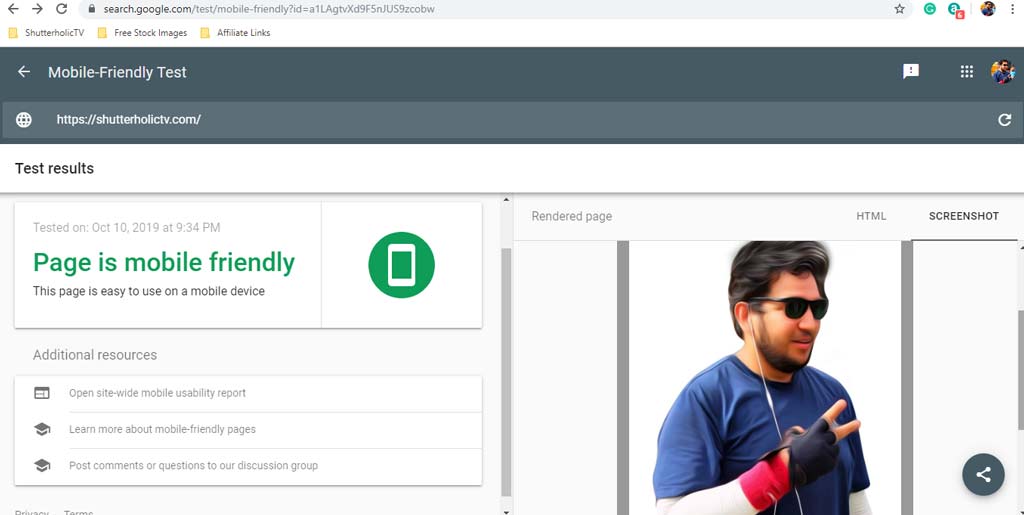
You just need to enter your URL and the testing console tells you if your page is mobile-friendly or not. Look at the image below, where I tested my site.

Mobile-friendly update released by Google in 2015 to track mobile-friendly web pages
Testing console for testing mobile-friendly web pages as per mobile-friendly update.

Mobile-friendly update coverage

There was a substantial fuss about what would be covered under this update. However, Google was clear about the coverage of this update. Listed below are some key facts and points.

  • This update only affected searches happening on mobile devices
  • The update applied to individual pages and not to the complete website as a whole
  • The coverage was global and not region-specific

Mobile-friendly update made perfect sense as if I try to search for anything on my mobile device, I want to see only mobile-friendly web pages. If my Mobile-friendly search showed pages which are not optimized for the mobile device, man I would go crazy. So this was about the mobile-friendly update. If you have any questions related to the topic please drop your comments at the end of the page and I will try to answer them ASAP.

Google’s Payday Load Update

The last three years were filled with activity. Google’s SEO went through massive changes. Panda, Penguin & Hummingbird updates were rolled out in the years 2011, 2012, and 2013 respectively. In the month of February 2014, Google updated its search page layout. In May the same year payday loan update 2.0 was released. The original one was already running. This release made the payday algorithm universal.

This meant that the update was now working on international queries as well. Not just English. In May there was another update. Panda was revised to Panda 4.0. Furthermore, let me try to define this update. The payday algorithm was amazing. This Google payday update basically refreshes Google’s search rules. By doing this payday update was on a hunt to track down websites that were manipulating SERPs. Websites using black hat SEO to gain rankings higher were penalized.

The payday update weed out any webpage that was engineered to rank higher through spam techniques. Furthermore, this update not just penalized bad webpages but good ones too. Payday loan update was not liked by a lot of webmasters who were manipulating SERP’s.

What was the need for Payday loan update 2.0?

I create a website. Now, in order to get a ridiculous amount of traffic I want to rank my website higher in the searched. The best way of doing this is to write amazing content on-page and off-page SEO and build authentic & quality links. I do that now since I know about white hat SEO. However, there were few webmasters who were using spam techniques to rank higher in searches. Even though the webpage content was crappy and was of no value to the user. This payday loan update was hinting down these webpages and was penalizing the sites.

Google obvious wants the quality pages to rank on top and not crappy ones. During the same time, Google was now paying more attention to quality of content. This was a major SEO indicator. This means that even though you could rank higher by using web spam techniques, however, you won’t be up there for long. This update will refresh the algorithms and your webpage will be penalized. You need to deliver amazing content only then your page will deserve to be at the top.

Quality content was always the key to be on top in the searches. Only now that Google has more smart algorithms to determine content quality. In other words, it is now not easy to use malicious techniques to get your website on top of the searches.

Google will help you

Call this amazing, but Google will help you in creating quality content. There is a specific guideline in places for webmasters by Google. I will cover this extensively in my future articles though. In the meantime, you can go through this page for more understanding. In case you have any questions on Google’s payday update, please let me know in the comment section below.

MTB Himalaya 2019 – Trilok Kumar Provelo’s adventure escapade

Trilok Kumar Provelo, this is not the first time this name has popped up on my blog. Some of you who have been with me from the start must have heard about him. I wrote an article earlier about him when he cycled continuously for 24 hours. This time he almost slew MTB Himalaya 2019.

There has been a recent surge in the number of MTB riders in India. Now, Trilok Provelo is a well-known name in road cycling. Most noteworthy is that he is also a founding member of Jaipur’s now biggest athletic community who loves clicking their pictures when working out.

Himalayan mountain biking is the toughest bike race in the country. The fact that in the year 2011 104 MTB riders started the race but only 42 could finish makes me believe this.

Take a moment and look at our cycloshot tribe group in Jaipur. In case you want to join us please do, connect with any of the admins mentioned on cycloshot tribe page. Better yet connect with me. Wink wink!

Now, before we go further please subscribe to my YouTube channel. Click here and watch the videos of my recent trip to Ladakh.

What is MTB Himalaya?

MTB Himalaya is an annual mountain biking race organised by HASTPA. HASTPA is Himalayan Adventure sports & tourism promotion Association. jointly by Hero Cycles and Himachal Tourism. This race was started way back in the year 2005 and is being held every year since then. Officially this race is for 8 days, which consist of 6 race days, one day rest and one flag off day and a small ride. Let’s take a look at the stages one by one in which Trilok Provelo participated and became the first rider from Rajasthan to finish it.

Stage-1 Balkhus Epiphany Day-1

MTB Himalaya stage -1
MTB Himalaya Stage-1

With difficulty level moderate this Himalayan mountain biking stage 1 needs MTB riders to cover a distance of 64.5 km. Elevation gain is moderate, consider it a warm-up ride for MTB riders. The race starts from Dak Bagla and ends at Gada Kuffer. Elevation jumps to 2480 meters and minimum goes till 1650 meter. This stage has two pitstops or feed stations.

Stage-2 Sutlej Symphony Day-2

Trilok Provelo featured in MTB Himalaya
MTB Himalaya Stage-2

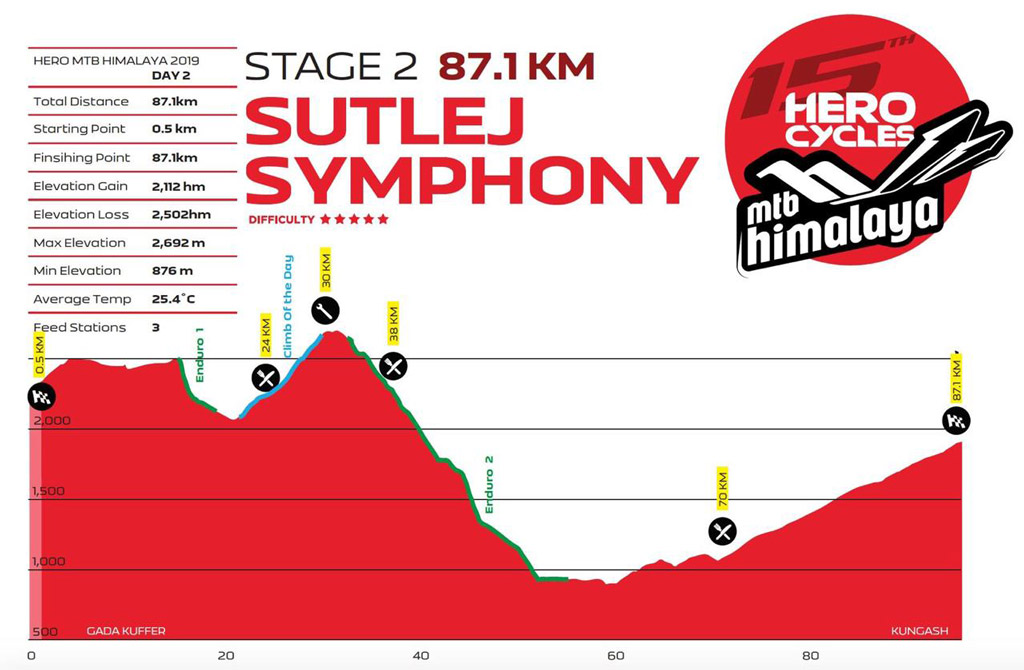
The second stage is a bit more on the tougher side. This day is scheduled from Gadakufar and ends at Kungash. Maximum altitude being 2502 meters and the lowest being 876 meters. The second day will test your skills. The distance covered is 87.1 km. Himalayan mountain biking is tough and this race makes you believe it. This stage has three pitstops.

Stage-3 Daruk Vana Day-3

Himalayan mountain biking
MTB Himalaya Stage-3

This is again one of the toughest section of the race. Furthermore, with over 2810 meters elevation and minimum elevation being 1505 meter, you need to cover a distance of 72.5 km. The flag off is from Kungash and ends at Gada Gushani. This stage has three pitstops. This stage is also called as the queen’s stage.

Day-4 is the rest day.

Stage-4 Divine Lap Day-5

MTB Himalaya Stage-4

The stage-4 of MTB Himalaya gives you a little relief. Difficulty levels of this stage are less than the last two stages. The maximum elevation is around 3000 meters and the minimum is 969 meters. The flag off is from Gada Gushani and ends at Pandoh, covering a distance of 72.2 km. This stage has three pitstops.

Stage-5 Stairway to Heaven Day-6

Trilok Provelo setting trend of mountain biking in India
MTB Himalaya Stage-5

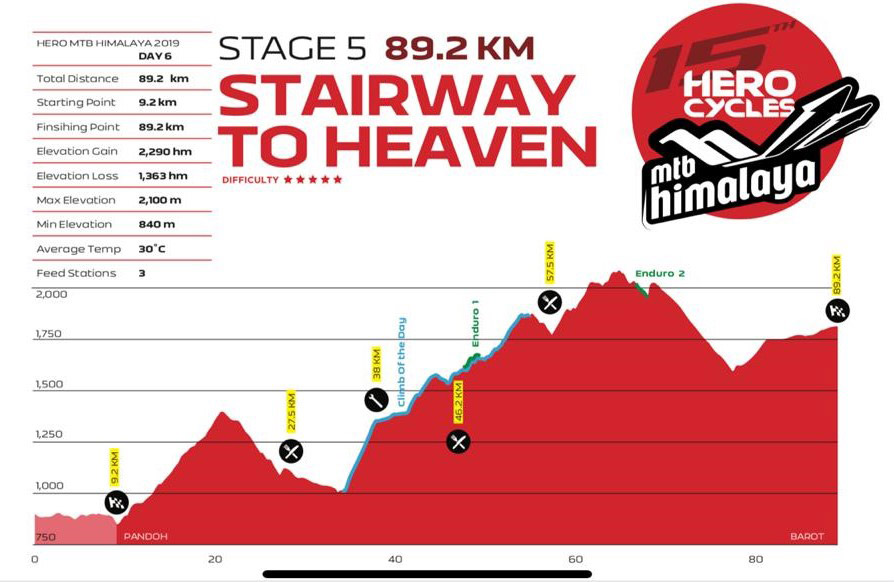
Similar to stage-1 the difficulty level is a bit less. This race starts from Pandoh and ends at Barot. Distance covered is 89.2 km. The highest elevation being 2078 meters and the lowest being 840 meters. This stage again has 3 pit stops.

Stage-6 Into the wild Day-7

MTB Himalaya & Himalayan mountain biking
MTB Himalaya Stage-6

This is the last day of the race and most noteworthy the last stage. The flag off is from Barot and the race ends at Bir. The distance covered is around 58.2 km with a max elevation of 2700 meter and a minimum of 1370 meter. This stage again has three pitstops.

Unfortunately, while writing this article I found my self on the MTB Himalayan website. The website has a little old and outdated information as far as the stages are concerned. The latest MTB Himalaya only had 6 stages as compared to a website which shows 8 stages.

Nevertheless, Trilok Kumar Provelo has once again proved to an outstanding contender for this event. He became the first cyclist from Rajasthan to finish this tiresome and brutal race. Along with Trilok Kumar Provelo, MTB Himalaya became 3rd MTB event in the world to complete 15 editions. I wish them all the best and hats off to HASPTA, Himanchal tourism and Hero cycles for keeping this intact and making it happen every year. Check out a few more pictures by Trilok below.

Check out why cyclists are crazy?

Google’s Hummingbird Update

So the years 2011 and 2012 were full of activity. Google’s Hummingbird update was rolled out in 2012. Google rolled out first the Panda Update and then the Penguin update. These updated algorithms changed the way everyone looked at SEO. However, Google wanted to do more. They were on the brink of introducing voice-based search results. Exactly, they were now moving to become the one and only amazing search engine in the world. It’s not that Panda and Penguin updates were not revised from time to time. However, Google was thinking of unleashing a fresh new update which would not be an update for Panda and Penguin but a fresh new update. More likely they wanted to keep this hummingbird algorithm a separate entity helping with the new Voice Recognition Search. 2013 Google update was much more than giving a new look to Panda and Penguin. So the world’s biggest search engine rolled out Google’s Hummingbird Update.

Why the word hummingbird in hummingbird update?

Google's Hummingbird Update
Google’s Hummingbird Update

Google choose this word for a reason. The characteristic of a hummingbird is that this bird is fast and accurate. This is exactly what Google wanted to offer its user in SERP’s. 2013 Google update of hummingbird came with a new algorithm. This update was launched on August 20th 2013. However, this was not disclosed to the SEO community until September. They kept on updating eh Panda and Penguin algorithms, however, the hummingbird algorithm was for a totally different reason.

Voice Recognition Search

Google was moving way past then traditional searches. They worked and got speech-based searched in their SERP’s. If you look at Google algorithms they are basically mathematics-based equations. Equations that take into consideration around 200 parameters for searches. Page rank and incoming links are just two of the 200 components. Now, if you look at the fact that Panda and Penguin updates could also so this. However, they were not as accurate as of the hummingbird. This update was fast and accurate, although some webmasters disagreed.

Google wanted the user to just say the phrase and get corresponding accurate search results. This was awesome, I mean think about the idea 18 years back when people could say things to their phone and get results on the web. Imagine speaking “Google, tell me where I can buy an iPhone”. What you get is names and addresses of all the iPhone dealers around you.

This has become now very easy thanks to the Hummingbird update from Google. The old panda and penguin updates could not do this efficiently, however, hummingbird could.

How did it work?

Well, suppose you say a phrase. google hummingbird algorithm would look for pages which match the phrase. Based on the 200 components of ranking in SERP’s, Google will display the results. A page which has the exact phrase would have a higher chance of ranking up in the search engine. If no pages were found with the phrase, then Google used to hunt pages with important and more searched keywords such as iPhone in this case.

The idea behind this update was to know the user intent and return the results based on intent of the user. Google did take into consideration the location of the user as well. So this way user gets the results from the area where he is from. This update still exists today and does an amazing job when you speak something on your phone to find something.

In the month of December the same year, there was a drop in the authorship and rich snippets displayed in the SERP’s. In this feature, Google displayed a picture of the author next to the listing in the SERP’s. However, this was removed from the searches in the same year.

Summing Up Hummingbird update from Google

This was an amazing algorithm from Google. It helped the user search for anything by just speaking. A voice-based search was something new and less time-consuming. This update delivered fast and accurate results. If you have any questions related to hummingbird update from Google, please leave a comment below.